Monday, April 4, 2016

Holly's Kestrel Photo of the summer

Throughout the spring the Kestrels continues to feed at a voracious pace - both male and female.
 
The male Kestrel brought voles in a couple of times an hour
The female Kestrel also fed on voles. 


The two of them captured voles, lizards and even small snakes.


It was rare to see the two together but even more rare to see them without food.

The shot I missed numerous times was of the male returning to the fence and handing his food to his mate. It happened many times, I would take the shots leading up to the transfer then miss the split second transfer of food.

We have the tendency to place human emotion and reasoning on wildlife to explain their actions. I am guilty of that but also aware that I am doing it so I always caveat my comments with a "I know they are not human - but I interpret their actions this way." That said - I know they are not human BUT - there is something endearing about the male Kestrel giving his food to the female to ensure his off-spring have the best chance of survival.

The following picture captures the exchange - read into what you will - but know that I am profoundly proud of Holly for taking the picture.  She saw the moment approaching, stepped up to my tripod mounted camera and took one picture - BAM, she got it.

 
The male on the left is gently handing his vole to his mate. I say gently because it looks like she is tearing the vole from him, not true, she is just firmly grasping the offered vole.

Tomorrow the fruits of their labor...


Sunday, April 3, 2016

Kestrels - Sleek and Fluffy

My favorite Kestrel photos are from a couple of years ago - we're currently waiting by the window with fingers crossed in hopes they will use our Kestrel house again this year.  When I went back to review and refine photos for this post I stumbled across this picture that appears to be a completely different species of Kestrel - soft and cuddly. This little guy has spread almost every single feather from each other - if you zoom in you can see how the spots appear at the end of the feathers - incredibly beautiful. 
 

The following is a series to show how a slick hunter can appear a docile fluffy aviator.  

On a May afternoon this male - paired with the female from the previous post - landed on our Shepard hook with a vole...and looked directly at me.


He gave a short cry over his shoulder then began to shake - much like we do when we shiver.


1/800 of a second was not fast enough to slow down the shivering wings


A few milliseconds of "shivering" and he has gone from a sleek, slate colored killer to an adorable fluffy bird - still holding a vole.


The photo series of his "shiver" lasted less than a second - quite the transformation in slow motion. Finished, he gave me one more look, a cry and then flew off to finish his meal...and kept hunting.


Less than 5 minutes later he reappeared with a lizard who - with all apologies to the lizard - looks like he is smiling for the camera. And yes that lizard has a blue underbelly - and yes I had no idea that those kind of lizards existed in our area. 

I hope you enjoyed today's post and the rare chance to take a close look at the fine feathering of this incredible Kestrel.

More to follow...

Friday, April 1, 2016

American Kestrel - A Fighter

Yesterday I included a (?) in the title because the Kestrel is the smallest hawk and you'd be correct to question their fighting spirit. I know better; today's photos are just one example of the tiny Kestrel showing off their big heart and feisty attitude.


One afternoon I saw this female - the same one who would be one half of "our" couple of the summer. She held a vole in her talons but let's be honest, there is not much meat left on the bone - it's a remnant of a vole. But it is hers.
 

If you live in the West you recognize the Magpie swooping in to steal her vole. The Magpie is similar in size to a crow and shares the same high intellect but has an ugly squawk. They hang out as a mob numbering around 20-25 composed of extended relatives; aunts, uncles, cousins. Their collective squawk, especially early in the morning, is enough to make them a nuisance.  
 

Our female Kestrel is especially annoyed at the Magpie's presence but is not intimidated in the least.


After the attack she held her ground and screamed out her frustration. 


Moments later the Magpie was back to try his intimidation tactics a second time.


She watched as the Magpie hopped off the fence and looked ready to pounce. 


She was having none of it. The American Kestrel's fighting spirit is not to be denied. Out-sized and facing an enthusiastic attack this little lady faced down the Magpie and held onto her meal.

She would need that nutrition over the next couple of months. More Kestrel photos to follow...

Thursday, March 31, 2016

American Kestrel - A Lover Not (?) a Fighter

As hot afternoon light gave way to crisp, golden spring late afternoon light I was intrigued to see a lone female Kestrel on a corner fence post. I set up my camera gear to take a nice photo in the late afternoon light - and was surprised by the following event - one that I will most likely never see again; Kestrels mating.

The beautiful princess
The smaller male, with his slate colored wings, surprised both of us when he landed onto of the bigger female.


He fought for his balance with his wings not, if you look closely, with his talons. He does not appear to dig his talons into her upper back in any of the photos.


I am certainly not a bird mating expert so I can only guess if the positioning was correct enough to produce the desired result.


This photo is my favorite - it captures an extraordinary moment I will most likely never see again and yet I am more amazed at the exquisite colors and patterns of the feathers. When I look closely I cannot help but see the American Kestrel as a beautifully drawn flying piece of art.

The rest of the story: When I was on a photo safari in Kenya and Tanzania many years ago I was in a vehicle that pulled up short and stopped in front of a river crossing. To our front, blocking our crossing, where two hyenas locked in the classic mating "doggie style" position. (As a "doggie" type animal I would imagine their options are limited.) I took a whole roll of film - yes, it was that long ago - as my fellow passengers looked on and giggled.  I took the whole roll to get an image similar to the one above - both creatures looking at me while in their mating embrace.  I had seen postcards in local hotels that featured mating animals - as joke postcards - and I knew I had "the" picture for their postcard. Afterward I contacted that postcard company and sold them the image. Years later one of my Air Force Special Operations brethren was in Africa, saw the postcard with my hyena image on it, bought it and returned to the States to surprise me with "my" postcard.  


These two Kestrels did their deed, listened to my story and are apparently as bored as you have been. My story aside, I hope you enjoyed the incredible moment I was lucky enough to witness and even luckier to capture on digital "film."

More images of the fruits of their labor to follow...

Wednesday, March 30, 2016

An American Kestrel family saga

The American Kestrel is one of my favorite birds; a fighter, a lover, one who hovers, a provider and a fierce competitor - what's not to love. The Kestrel is the smallest hawk and can be compared in size to a Robin, though a little more robust. The are exquisitely colored and have a fantastic "eyes in the back of their heads" feathering.

The story of "our" 2013 Kestrel family cannot be told in a single blog, so I'll space it out over a few. As you read the posts PLEASE keep your fingers crossed that our Kestrel box will be occupied again this summer. We've seen both males and females checking it out, it has fresh wood shavings ready for a new family.

I put up a Kestrel box a few years ago yet it went unoccupied for at least the first couple of years. It is in a prime location, plenty of voles to be had along a hillside that usually has southerly winds to aid the hunters.

In the spring of 2013 we spotted a male Kestrel hunting in the area - he quickly winged his way into a hover then stayed stationary while craning his neck looking for voles. In between sorties he landed on our wooden fence looked at me then gave me a good look at his faux face.


We started to get excited when we saw a pair of Kestrels in the area. The "lady" is on the right of the photo - she is holding a vole in her talon. Note the color and size differences; he has pretty slate blue wings, she is bigger and has pretty patterned wings.


Soon enough she took up residence in the box while he began his "vole delivery" service.


She received her delivery but flew off instead of eating in house

He began a vigorous delivery service

He even added horny toads to the menu
 

The male was very attentive throughout the month of May as the pair of Kestrels readied the box for their young.

More of the Kestrel family saga to follow.

Tuesday, March 29, 2016

Snow day Birds

Aaah Yes! I remember the beautiful blue Utah sky and warm temperatures. Today is not that day, I am fighting a snow induced funk - cold, white skies with snow blowing sideways.

Thought today would be a chance to reach back to grab two photos that made an impact on me, and hopefully you.

Yesterday I mentioned seeing a bird with a nictating membrane that was fully opaque.

A few summers ago I photographed a pair of Swainson's Hawks - dark morph - over a couple of weeks as they patrolled the hill behind our house. A strong southerly wind provided enough constant lift for them to effortlessly hover while scanning for voles.  Their eyes can detect the ultraviolet wavelength of a vole's urine which leads to the vole.


One of the hawks hovered over our back deck - right above me - and "blinked" as I took the photo.


The resulting opaqueness (only slightly Photoshop enhanced for effect in this cropped photo) combined with out-reaching talons gives this bird a sinister look. It thought better of choosing me for lunch - I was either too heavy to carry away, too hard headed or too old and tough - all of which are true...sadly.

More birds came to the party on the back hill - I was lucky to catch this one after he tucked his wings and dove at high speed to snatch a vole. After years of photographing birds in flight I rarely get them in this posture they are just too fast.


The photo below is a more common posture - cruising in the wind while looking for food. This is the photo I sent to an expert for assistance in identification. I will share my embarrassment with you in order to help you not make the same rookie mistake I made.

These last two pictures are the same bird - white and brown yet it is a red-tailed hawk. The fact that it didn't have a red tail threw me off, though there is a hint of red in the second photo. The expert kindly told me that the red tail hawk is the only bird of prey with a patagial mark (see arrow). Apparently it is is a well know ID mark and can vary in darkness - okay, now we all know how to ID red tail hawks.


Tomorrow I'm breaking out some of my favorite Kestrel photos, including one that Holly took.

Monday, March 28, 2016

The eyes have it - take a close look - who knew


It all started with the Ibis, my Dad and I and were watching one walking in a marsh and I asked if he noticed the color of the eyes. He hadn't noticed the eye color. If he didn't, I can understand if it may have slipped by others too. This post is dedicated to the eyes of the birds we photographed in the Everglades.
 
An Ibis wading along Turner River Road

Zoomed in to reveal the beautiful blue eyes

Little Blue Heron in Corkscrew Swamp Sanctuary
 
A closer look at the pale yellow eye
 
"Blinking"

The Little Blue Heron was caught "blinking" which is actually a third eyelid - the nictating membrane - which lubricates the eye. I've taken photos of birds of prey where the nictating membrane is fully opaque creating a creepy other-worldly look.

A Great Egret along the road in Fakahatchee State Preserve

The Egret eye catches the light and looks like a marble
This Great Blue Heron was "giving me the eye" in Shark Valley
A closer look reveals the same marble effect


Another Shark Valley resident - a tri-colored heron
 
Zoomed in to highlight the wonderfully colored eye

The jewel of the Everglades -the Purple Gallinule
The PG also has a beautiful red eye to go with its candy corn beak

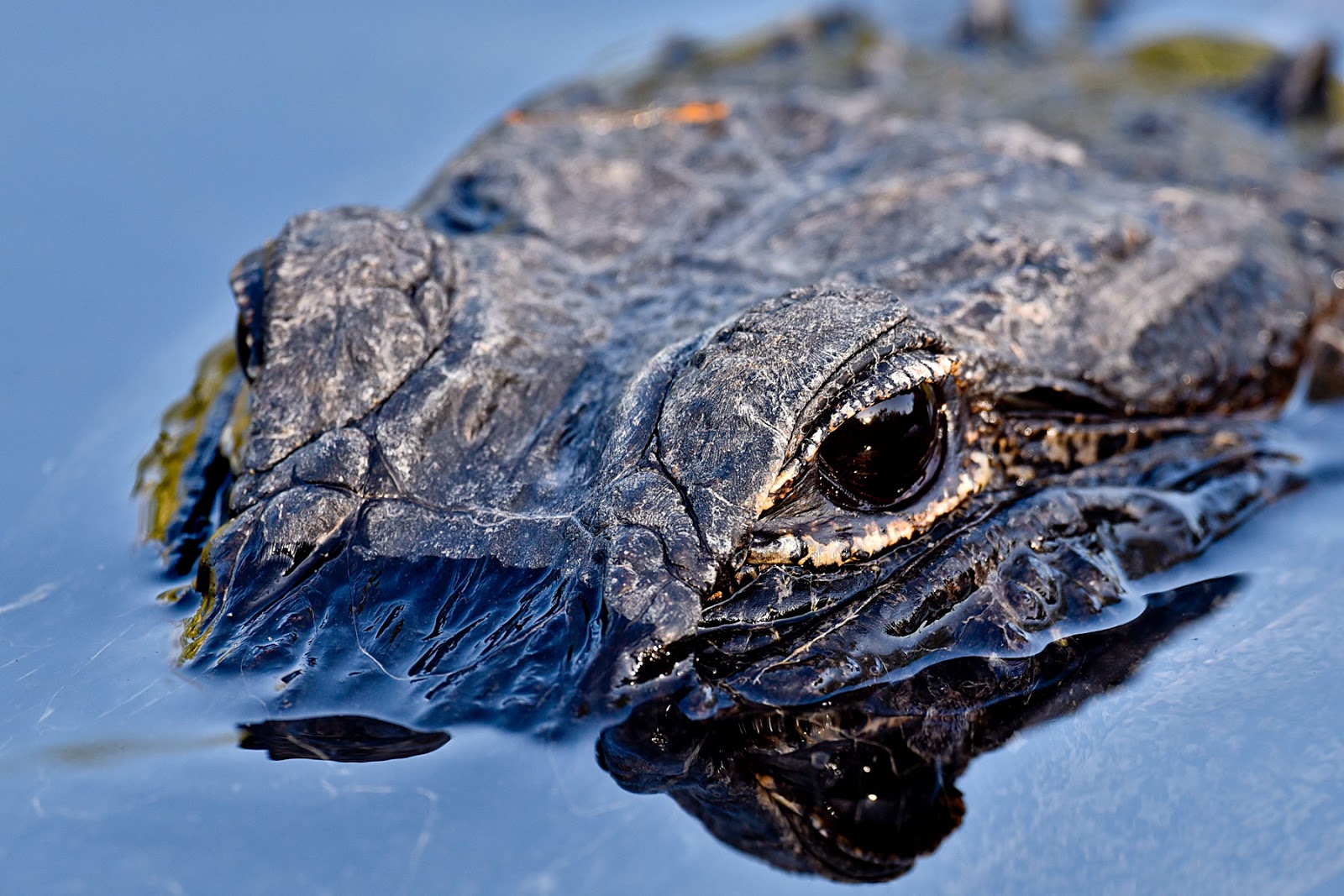
Lastly, I was reviewing my bird photos, intent on picking out never before posted photos to demonstrate the different bird's eyes when I came across an alligator photo. I opened this image in Photoshop and moved a slider the wrong way - making the photo too light...however it revealed a remarkable find.
An alligator along Turner River Road

Look closely
A closer, albeit an accidentally lighter, look reveals a slit in the eye that reminds me that this alligator is a descendant of the dinosaurs. Doesn't this look like an eye from a dinosaur in "Jurassic Park?" It does to me. The trees and setting sun reflected in the gator's eye are spectacular. The little ball of light in the eye however is not my flash going off - though it looks like a flash. I do not use a flash when taking wildlife photos - the ethics of which are hotly debated on some blogs - not here, I'm not looking for a fight or to push my agenda - so please do not debate it in the comments.

Thank you again for joining me and our treasured birds - each one different and yet similar - like all of us humans.

Tomorrow I'll be snowed in, under a foot of snow, if you believe the local weatherman - either way I plan on starting a series of posts with some good photos taken over the last few months.